How to Choose the Best 3D Color Printer for Your Needs?
When selecting a 3D color printer, knowing your needs is essential. According to James Carrington, a 3D printing expert, "Choosing the right 3D color printer could redefine your creative process." This statement highlights the importance of making an informed decision.
The market offers numerous options, but not all printers suit every purpose. Factors like print quality, material compatibility, and ease of use play a crucial role. For instance, some 3D color printers excel in detailed outputs but may struggle with certain materials. It's vital to examine your projects and select the right printer accordingly.
Additionally, budget considerations cannot be ignored. Some affordable models may deliver subpar results. Others may seem expensive at first but offer features that save time and enhance quality. It’s a balance of cost and capability. Reflecting on your specific requirements can guide you toward a more satisfying choice.
Understanding Your 3D Printing Needs and Applications
When choosing a 3D color printer, it's essential to understand your specific needs and applications. The market has grown significantly, with a 2021 report showing that the global 3D printing industry was valued at approximately $15.5 billion. It's projected to reach over $34 billion by 2026. This growth emphasizes the importance of selecting a printer that aligns with your intended use.
Consider what you plan to print. Is it artistic projects, prototypes, or functional parts? For example, art models may require high-resolution print capability, while industrial applications may prioritize durability and speed. An analyst report revealed that 30% of users reported dissatisfaction due to mismatched printer features. You should reflect on your priorities to avoid this pitfall.
Additionally, the diversity of materials you might want to use is crucial. Some printers excel with plastics, while others handle composites better. A 2022 survey indicated that only 25% of users explored multiple material options. Many users regret not considering this aspect early on. A well-chosen 3D printer can elevate your creative or business projects, but a hasty choice may lead to frustration and wasted resources. Understanding these factors can guide you toward the best decision.
Key Features to Consider in a 3D Color Printer
When selecting a 3D color printer, several key features must be carefully considered. Resolution is one of the most critical aspects. A printer with a higher resolution will produce finer details and smoother finishes. Many professional-grade printers offer resolutions as high as 20 microns. Lower-resolution options might lead to rough surfaces and a less polished final product.
Another essential feature is the color capability. The best printers can produce a wide color gamut. According to industry reports, models that can mix multiple filaments offer superior color blending. Multi-material capabilities enable users to create intricate designs and textures. However, not all printers handle mixed materials well, often leading to issues such as clogging or inconsistent extrusion.
Build volume cannot be overlooked either. A larger build area allows for more significant creations. However, larger designs can sometimes lead to warping during printing. Users might also find that larger prints take considerably longer, consuming more material and time resources. Balancing build size with quality is a challenge many face. Cheaper options often sacrifice one for the other. Finding a printer that meets both needs can be complex yet necessary.
How to Choose the Best 3D Color Printer for Your Needs? - Key Features to Consider in a 3D Color Printer
| Feature |
Description |
Importance Level |
Price Range ($) |
| Print Resolution |
The level of detail the printer can produce, usually measured in microns. |
High |
300 - 2000 |
| Build Volume |
The maximum size of the object that can be printed. |
Medium |
500 - 1500 |
| Filament Compatibility |
Types of filament the printer can use, like PLA, ABS, PETG, etc. |
High |
300 - 1500 |
| Printing Speed |
How fast the printer can operate, usually measured in mm/s. |
Medium |
400 - 1000 |
| User Interface |
Ease of use of the control panel, touchscreen vs. buttons. |
High |
200 - 1200 |
| Software Compatibility |
Programs compatible with the printer for 3D modeling and slicing. |
Medium |
0 - 1000 |
Types of 3D Color Printing Technologies Explained
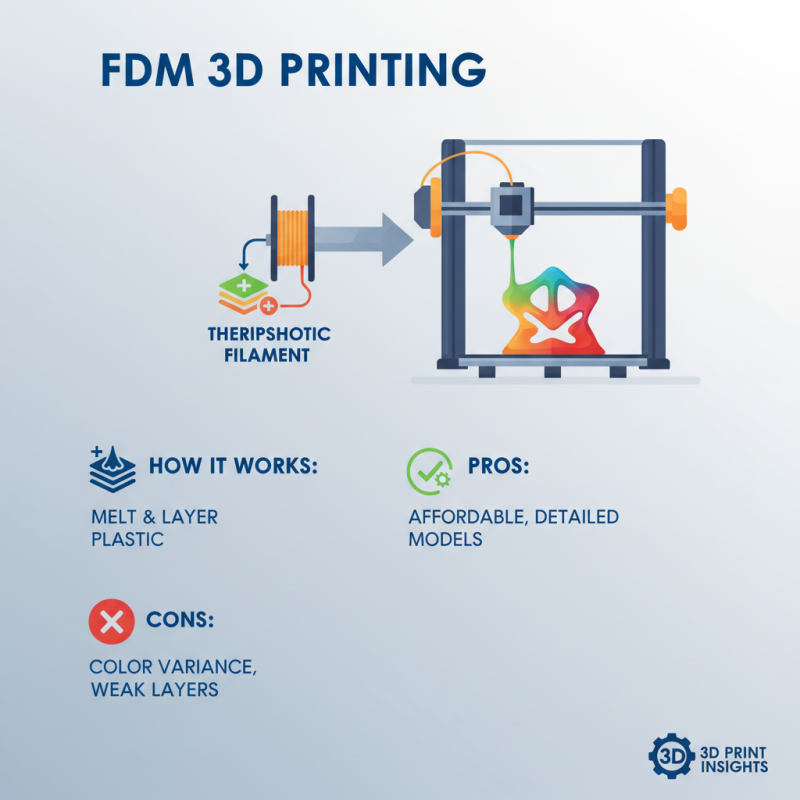
When exploring 3D color printing technologies, it's important to understand the options available. Fused Deposition Modeling (FDM) is a popular choice. It works by melting thermoplastic filaments. You can create detailed models, but color accuracy may not be perfect. Layer adhesion can sometimes be weak. This might lead to layers peeling apart.
Another technology is Stereolithography (SLA), which uses resin and UV light. SLA can produce incredibly smooth surfaces. The colors can be vivid and true to life. However, the process can be messy, and the resins often have strong odors. Cleaning and curing parts require careful attention, sometimes leading to frustration.
Lastly, Multi Jet Fusion (MJF) provides a unique approach. It uses a powder bed and liquid agents to build models. This method offers good color range and strength. However, it can be expensive and not widely available. Each technology has its pros and cons. Making a choice requires reflection on your specific needs. Consider what is non-negotiable for your projects.
Assessing Budget and Cost-Effectiveness
When choosing a 3D color printer, budget is a crucial factor. Prices vary significantly. Entry-level models may cost less but often compromise on quality. Higher-end printers offer better precision and color accuracy. Evaluate what matters most for your projects.
Consider the cost-effectiveness of materials too. Filament prices can add up quickly. Some printers use specialized materials that can be more expensive. Look for options that allow flexibility with materials. You might find a good balance between quality and cost.
Reflect on your own needs. Are you printing prototypes or artistic pieces? This will impact your budget decisions. Sometimes, lower-quality prints may suffice for drafts, but high-detail projects should not be skimped on. Know when to invest a little more. Choosing wisely can save money in the long run.
Evaluating Brand Reputation and Customer Support Options
When selecting a 3D color printer, brand reputation matters. Begin by researching customer reviews online. Look for patterns in feedback. Positive comments indicate reliability. However, even the best brands can receive criticism. A few negative reviews can reveal issues that may affect your experience.
Customer support options are equally important. A good printer is useless without support if something goes wrong. Check if the manufacturer offers easy access to help. Availability of live chat or phone support is crucial. Response time also plays a role. If support takes too long, stress levels rise when you need immediate assistance.
Consider warranty options as well. A strong warranty builds confidence in a product. However, reading the fine print is essential. Some warranties have limitations. Assess how these factors align with your needs. It’s an imperfect process, and sometimes you won’t find the perfect fit. Taking the time to evaluate these elements can pay off in the long run.