10 Essential Tips for Choosing an Lcd Resin 3D Printer?
Choosing the right LCD resin 3D printer can be a daunting task. The market is filled with various models and specifications, making it challenging for both beginners and experienced users. Understanding your specific needs is crucial. Each printer has unique features that can impact print quality and efficiency.
Consider factors like build volume, resolution, and cost. It's important to evaluate how these factors align with your projects. For instance, if you're working on intricate designs, higher resolution may be required. Personal preferences can also play a significant role in your selection process.
Furthermore, it's essential to remember that no single printer is perfect. While some may excel in speed, they might compromise on detail. Some buyers overlook the importance of user support and community feedback. Engaging with experienced users can provide valuable insights. Ultimately, choosing an LCD resin 3D printer involves balancing various elements. Taking the time to reflect on what matters most to you will lead to a more informed decision.
Key Considerations for Selecting an LCD Resin 3D Printer
When diving into the world of LCD resin 3D printers, several key considerations come into play. The resolution and print quality are paramount. Most high-quality printers operate at 4K or 8K resolutions. A study by the Additive Manufacturing Institute indicates that models operating at 8K resolution can produce prints with finer details and smoother surfaces, attracting professionals seeking precision.
Another crucial factor is the build volume. A larger build area permits bigger projects, which is essential for designers and engineers. Current market analysis shows that the average build volume for LCD resin printers ranges from 120x68x155 mm to 300x300x400 mm, accommodating various sizes of prototypes. However, larger volumes may lead to longer print times and increased resin consumption. It's essential to find a balance that matches your project requirements.
User-friendliness is often overlooked but greatly affects the printing process. Some printers feature touch screens and easy calibration. A survey by 3D Printing Review highlighted that nearly 30% of users prioritize ease of use when selecting a device. Additionally, the availability of support and community engagement is vital. Engaging with a community helps users troubleshoot issues and share best practices. Ultimately, making an informed decision requires weighing these factors against your specific needs and future projects.
Understanding Different Resin Types and Their Properties
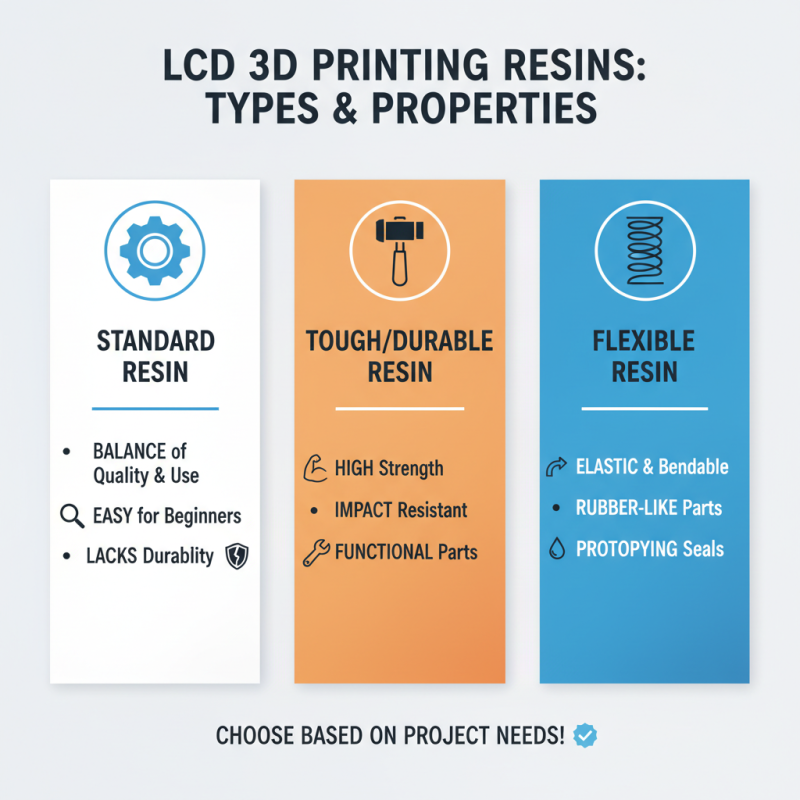
When selecting an LCD resin for 3D printing, understanding the different types of resins is crucial. There are various resins, each designed for specific applications. Standard resins offer a balance of quality and ease of use, making them a great choice for beginners. However, they may lack durability. It’s essential to think about your project's needs and choose accordingly.
Specialty resins can enhance the final product’s properties. For instance, flexible resins allow for elasticity and are ideal for creating prototypes with moving parts. On the other hand, tough resins provide high impact resistance, ideal for functional parts. While they offer advantages, these specialty resins can sometimes be more challenging to print.
The curing process also impacts the resin’s performance. Some resins require longer curing times, affecting efficiency. Inconsistent settings can lead to unexpected results. Experimentation may be needed to find the perfect balance. Carefully considering these factors will help ensure you select the right resin for your specific application and avoid common pitfalls in the 3D printing process.
Assessing Build Volume and Print Size Requirements
When choosing an LCD resin 3D printer, assessing build volume and print size is crucial.
Build volume refers to the maximum dimensions of a model that the printer can produce. A larger build volume offers more versatility, enabling you to print bigger objects or multiple smaller items at once.
According to industry reports, nearly 70% of users find that limited build volume constrains their creativity. This statistic emphasizes the importance of evaluating your specific needs before making a purchase.
Print size requirements often depend on the projects you'll undertake. For example, industries such as dentistry and jewelry require precise and smaller details, while prototyping for manufacturing may need larger scale models. Even within these parameters, the range of print sizes can vary significantly across different printers.
Some models may excel in very fine details, while others prioritize speed or larger outputs. A study found that 65% of professionals had regrets due to mismatched expectations and printer capabilities. This illustrates the importance of carefully considering your build volume and print size needs before investing in a printer.
Evaluating Printer Resolution and Layer Thickness Options
When evaluating LCD resin 3D printers, printer resolution is crucial.
Higher resolutions yield finer details, which is essential for intricate designs.
A printer with 4K resolution displays sharper images than those with 2K.
Higher pixel densities result in smoother surfaces. Users should seek a balance between detail and speed.
Very high resolutions can slow the printing process.
Layer thickness is also an important factor. Thinner layers create smoother prints but increase print time.
A thickness of 0.01 mm offers excellent resolution and captures detailed features well.
However, users may find it limits their production speed. This is something to consider, especially for larger projects.
Higher layer thicknesses, like 0.1 mm, can speed up production. They may sacrifice some detail but are effective for
larger objects. Evaluating your specific needs can help make this decision easier.
Think about the purpose of your prints. Every project is different, meaning there is no one-size-fits-all solution.
Balancing speed and quality is key to successful printing.
Comparing Cost and Maintenance of Various 3D Printer Models
When choosing an LCD resin 3D printer, cost and maintenance are critical factors. The price range for these printers varies widely. Entry-level models can start around $200, while high-end options can exceed $3,000. According to industry reports, beginners often lean towards affordable models to minimize risk. Yet, long-term costs might be higher due to limited durability and expensive resins.
Maintenance requires attention and should not be overlooked. Regular cleaning and occasional part replacements are necessary for optimal performance. Most users spend between $100 to $300 annually on maintenance. An overlooked factor is the environmental impact of resin disposal. Some resins are less eco-friendly than others, leading to increased waste management costs. Potential buyers should factor in both purchase price and long-term maintenance expenses for a comprehensive budget.
While the capabilities of higher-end printers are appealing, users should weigh these benefits against the maintenance requirements. Advanced features may lead to more frequent repairs. Understanding the trade-offs ensures better decision-making. Selecting the right printer balances initial investment with expected upkeep, shaping the overall experience of 3D printing.