2026 Best 3D Printer Filaments for Global Buyers
Choosing the right 3d Printer Filaments in 2026 requires more than comparing colors, prices, or glossy product photos. Global buyers face different climates, shipping conditions, machine standards, and application demands. A spool stored in humid Singapore may behave differently from one used in dry northern Europe. Moisture changes print quality. Poor winding can cause sudden feeding problems.
Chuck Hull, the inventor of stereolithography, said, “The important thing is to make things.” His principle still matters when evaluating modern filament materials. Good 3d Printer Filaments should help users create dependable parts, not merely attractive prototypes. That means examining diameter consistency, moisture resistance, layer bonding, heat tolerance, and packaging. It also means checking technical data, testing small samples, and comparing real user experience.
This guide reviews leading filament choices for international buyers. It considers PLA, PETG, ABS, ASA, TPU, nylon, and reinforced blends. Each material has strengths. Each has compromises. PLA prints easily, but it may soften under heat. Nylon offers toughness, but it demands careful drying. ASA performs well outdoors, yet ventilation remains important. No ranking can fit every workshop.
Some conclusions may change.
Manufacturers improve formulas, and suppliers do not always maintain identical quality. Therefore, this overview uses practical criteria rather than marketing claims alone. Expect useful recommendations, but not perfect certainty. Your printer, nozzle, storage habits, and local environment still influence the final result. Test before buying in bulk. That small step can prevent wasted filament, failed parts, and unnecessary shipping costs.
Define 2026 filament grades by 1.75 mm diameter and ±0.05 mm tolerance
2026 Best 3D Printer Filaments for Global Buyers
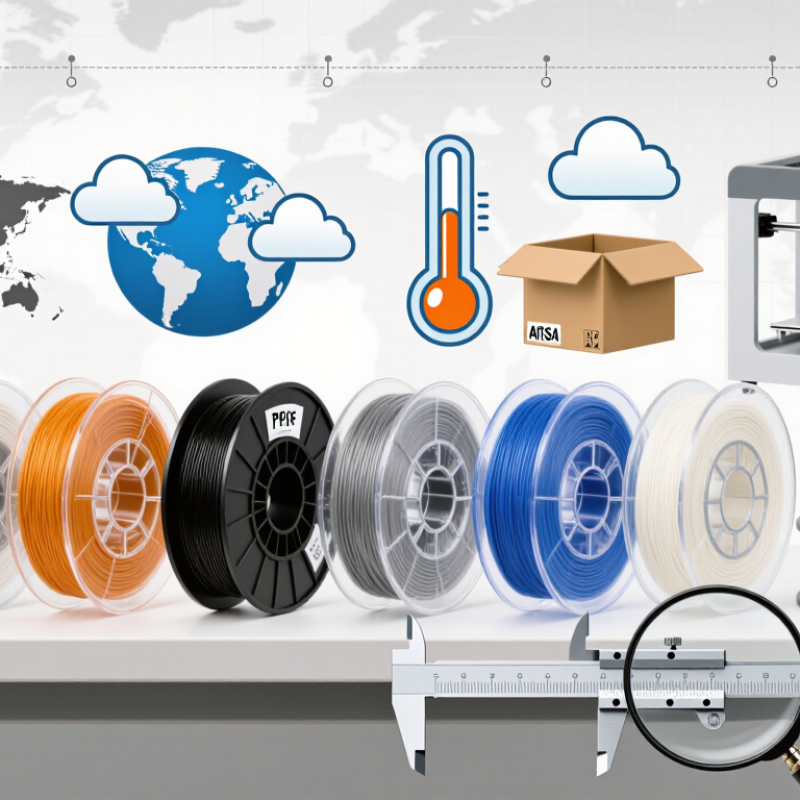
For 2026, a practical filament grade begins with a nominal diameter of 1.75 mm and a tolerance of ±0.05 mm. This means each measured section should remain between 1.70 and 1.80 mm. That range supports steadier extrusion, more predictable flow, and fewer sudden under-extrusion marks. Buyers should treat this specification as a performance foundation, not a complete quality guarantee.
In production checks, measure several points along the spool with a calibrated digital caliper. Rotate the filament during testing. A single measurement can hide ovality or inconsistent extrusion. Record readings near the beginning, middle, and end of the spool. I have seen filament pass a label check but vary noticeably after long storage. Moisture, winding tension, and temperature can also affect printing results. The specification still matters, but it needs evidence.
A useful buyer grade can include 1.75 mm diameter, ±0.05 mm tolerance, moisture-controlled packaging, and batch inspection records. Ask for test data rather than relying on attractive packaging. Smaller diameter changes may cause visible gaps on thin walls. Larger sections can increase flow and create rough corners. This is where printer calibration matters. Even so, filament should not force constant correction. The tolerance target is clear, but real-world consistency deserves closer review.
2026 Best 3D Printer Filaments for Global Buyers
Filament grades shown here use a nominal diameter of 1.75 mm with a dimensional tolerance of ±0.05 mm, giving an acceptable diameter range of 1.70–1.80 mm. The chart compares representative nozzle and heated-bed temperature midpoints for common material classes.
How to read the chart: Processing temperatures are typical midpoint values derived from commonly published ranges: PLA 200–220°C nozzle and 50–60°C bed; PETG 230–250°C and 70–85°C; ABS and ASA 240–260°C and 90–110°C; PA 250–280°C and 70–90°C; PC 260–300°C and 90–120°C; TPU 210–240°C and 40–60°C. Actual settings should follow the technical data for the specific filament formulation and printer.
Compare PLA, PETG, ABS, ASA, TPU, and Nylon using ASTM D638 data
2026 Best 3D Printer Filaments for Global Buyers
ASTM D638 offers a useful framework for comparing PLA, PETG, ABS, ASA, TPU, and Nylon. It measures tensile strength, elongation, and elastic modulus using molded or printed specimens. However, filament data is not perfectly interchangeable. Printer settings, layer direction, infill, drying, and specimen conditioning can change results sharply.
PLA usually provides high stiffness and clean dimensional accuracy, but it can become brittle under impact or heat. PETG offers better toughness and moisture resistance, although its softer surface may reduce precision. ABS and ASA tolerate higher temperatures; ASA generally handles outdoor exposure more reliably. TPU stretches dramatically and suits flexible parts, while Nylon combines strong tensile performance with toughness. It also absorbs moisture quickly. Real workshop experience supports the pattern, but results can still disagree.
Tips:
Ask suppliers for ASTM D638 specimen type, test speed, temperature, humidity, and print orientation. Compare elongation as carefully as tensile strength. A strong filament may fail early between layers. Dry Nylon and TPU before testing. Keep records.
Do not treat one datasheet as universal truth. ASTM D638 improves comparison, yet it cannot reproduce every buyer’s printer, climate, or design. Some published values seem impressive, but missing test details weaken their reliability. Global buyers should request complete reports and test samples before placing large orders.
Set print temperatures from Tg: PLA 60°C, PETG 80°C, ABS 105°C
For global buyers, filament selection should begin with glass-transition temperature (Tg), not marketing claims.
These values describe heat resistance, not nozzle temperature. Use Tg as a thermal checkpoint.
In practice, PLA usually prints around 190–220°C, PETG around 230–250°C, and ABS around 240–270°C. Confirm the range with the technical datasheet and a small temperature tower.
I have seen identical-looking spools behave differently after storage. Moisture changes layer strength, surface texture, and stringing. Dry filament matters.
Bed temperatures also need attention. A heated bed near 50–65°C often supports PLA, while PETG commonly needs about 70–85°C. ABS may require 90–110°C and an enclosed build space to reduce warping. Keep cooling moderate for ABS.
ASTM F42 standards help define additive-manufacturing terminology and testing practices, but they do not replace supplier-specific settings. The Wohlers Report 2024 valued the global additive-manufacturing industry at about 20 billion dollars in 2023, with continued growth across polymers and industrial production. That expansion increases material choice, but not consistency.
Measure real results.
A glossy surface is not proof of strength. Recheck settings after changing color, batch, nozzle, or humidity. Temperature charts are useful starting points, not guarantees.
Evaluate moisture resistance through ISO 62 water-absorption data
For global buyers, filament moisture resistance should begin with ISO 62 water-absorption data. This standard measures mass gain after controlled water exposure or humidity conditioning. Published technical datasets commonly place PLA and PETG near 0.2–0.5% absorption, while ABS often remains around 0.3–0.8%. Nylon can exceed 2%, and some grades reach above 8% under immersion testing. These figures come from ISO 62 and ASTM D570-referenced material reports, including data compiled by engineering plastics databases. Test conditions matter greatly. A 24-hour result cannot equal a seven-day result.
A practical buyer should request the method, temperature, exposure time, and specimen geometry. ISO 62 data without these details is incomplete. During warehouse checks, weigh a sealed spool before opening it. Weigh it again after humid storage. Even a small increase can cause bubbles, rough walls, popping sounds, and weaker layer bonding. This is especially visible in nylon, where absorbed water can vaporize inside the nozzle. Dry room storage helps, but ordinary resealable bags may leak moisture over time.
Wohlers Report 2025 highlights material reliability as a continuing additive-manufacturing concern, not merely a printing-speed issue. Yet water absorption is only one indicator. I would also examine drying temperature, packaging quality, and reconditioning instructions. A low ISO 62 percentage may still disappoint after ocean transport. Laboratory numbers are useful, but they are not the whole journey.
Screen global suppliers by ISO 9001, REACH, RoHS, and shipping coverage
For global buyers, filament selection starts with supplier evidence, not color charts. The Wohlers Report 2024 valued the additive manufacturing industry at about USD 20 billion in 2023. That scale increases the need for controlled production and traceable materials. Ask for an ISO 9001 certificate, its issuing body, scope, and expiry date. ISO 9001 supports process control, but it does not guarantee perfect diameter or print performance.
Request current REACH and RoHS declarations for each material and additive package. These documents should identify the product, revision date, and responsible manufacturer. A generic compliance logo is weak evidence. Check batch records, safety data sheets, diameter tolerances, and moisture-sealed packaging. I would also request a recent sample before placing a large order. Small tests expose warping, inconsistent flow, or brittle spools quickly. They also reveal whether the supplier answers technical questions clearly.
Shipping coverage needs equal attention. UNCTAD’s Review of Maritime Transport 2024 reports that more than 80% of global merchandise trade by volume moves by sea. Confirm delivery options by destination, export documents, customs support, lead time, and replacement procedures. Ask whether stock is held near your market. A low unit price can lose its value after freight delays and damaged cartons. I still treat missing batch documents as a warning, not proof of failure. Certificates can expire, and supplier websites can remain outdated. Verify everything directly.