Choosing the best Metal 3d Printer in China starts with the job, not the brochure. A machine built for aerospace brackets may be excessive for dental parts. A compact system may struggle with large, repeatable production runs. The answer varies.
The market deserves careful comparison. Wohlers Report 2024 estimated that global additive manufacturing industry revenue reached about US$20.0 billion in 2023, an 11.1% increase from 2022. This growth signals wider adoption, but it does not identify one best printer or prove that every system suits every factory. Numbers matter.
This guide compares Chinese metal powder bed fusion systems through practical criteria: build volume, laser configuration, supported alloys, process monitoring, and local service. Consider a titanium component with thin channels, or a stainless-steel part that must be produced repeatedly. Those details can change which machine makes sense. Buyers should also examine independently verifiable specifications, sample-part quality, maintenance needs, and the availability of trained technicians. Even this comparison has limits: published specifications rarely show uptime under real production loads. A persuasive claim is not the same as production evidence. The strongest choice is the one whose performance, support, and total operating costs fit your specific application.
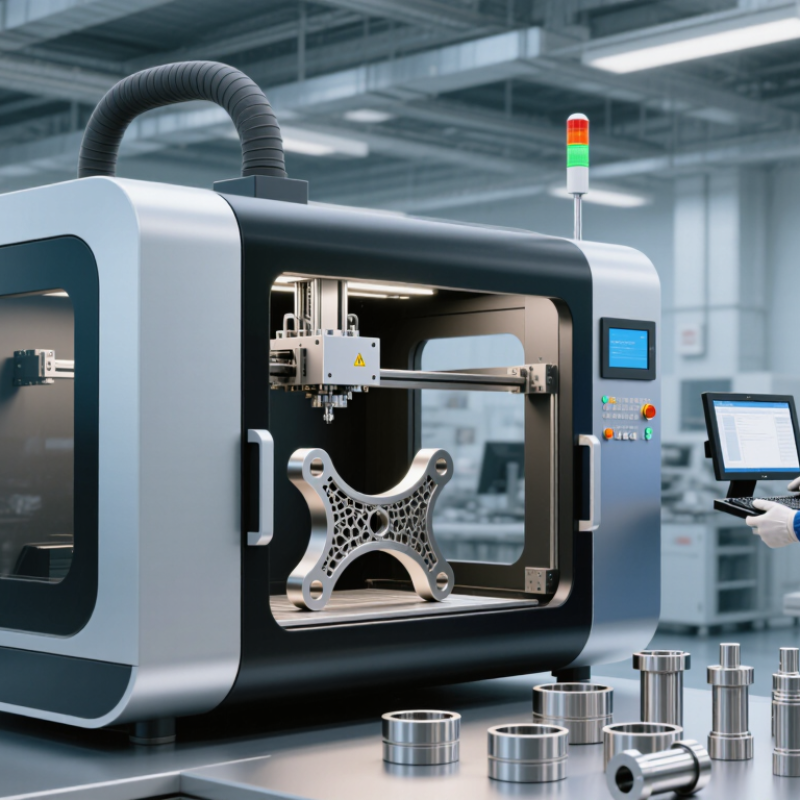
A metal 3D printer does not simply melt metal into shape. In laser powder bed fusion, a recoater spreads a thin powder layer, and a laser selectively fuses it. The platform lowers, and the cycle repeats until the part is built. Other processes, such as directed energy deposition, feed metal into a focused heat source and suit different repair or production needs. The method matters.
“Best” depends on the part, alloy, and production target. For thin aerospace brackets, fine features and stable powder handling may matter most. For larger components, build volume, deposition rate, and post-processing can weigh more. Buyers should compare validated materials, dimensional repeatability, machine uptime, local technical support, and the full workflow—not just advertised laser power. Small details count.
The market is growing, but growth alone cannot identify a top machine. Wohlers Associates’ 2024 report estimates that global additive manufacturing revenues reached $20.0 billion in 2023, up 11.1% from 2022. That figure covers additive manufacturing broadly, not metal printers alone, so it should not be read as a metal-machine ranking. For a China-based purchase, request sample builds using the intended alloy, inspect surface finish and internal porosity, and ask how results are measured. I would also check service response times; specifications rarely show what happens after a production stoppage. The answer may be less tidy than a league table.
What Is the Best Metal 3D Printer in China?
Key Technologies Used by Chinese Metal 3D Printers
Choosing a metal 3D printer depends on the alloy, part geometry, and production target. Many industrial systems use laser powder bed fusion, where a focused beam melts thin layers of metal powder. Galvanometer scanners steer the beam across each layer, while recoating systems spread fresh powder. A slight recoating inconsistency can leave visible defects. That matters.
Other machines use directed energy deposition, feeding metal powder or wire into a melt pool. This approach can suit large parts, repairs, or adding features to existing components. Closed-loop monitoring may track melt-pool brightness and temperature during printing. Thermal control, inert-gas circulation, and reliable powder feeding also affect results. Software helps, but it cannot correct every material or setup problem. No process wins every job.
Tips: Ask for sample parts made with your intended alloy and geometry. Check layer consistency, surface finish, and documented test results. Specifications are useful, but real production trials reveal practical limits. Even a promising system may need tuning.
China’s metal 3D-printer landscape is best understood by process, not by searching for one “best” machine. Powder bed fusion (PBF), especially laser-based systems, suits intricate parts with fine channels and thin walls. It is used for aerospace components, medical implants, and high-value tooling, but requires controlled powder handling and careful support removal. Details matter.
Directed energy deposition (DED) feeds wire or powder into a melt pool, making it useful for large parts, cladding, and repair. Its deposited tracks can be coarser, and finishing may add time.
Binder jetting prints with a binding agent before sintering; shrinkage must be anticipated. Metal material extrusion offers a lower-cost route for prototypes, but debinding and sintering can affect dimensional consistency.
Chinese manufacturers offer systems across these categories, yet build size, materials, and service support vary. Not interchangeable.
The Wohlers Report 2024 estimates global additive-manufacturing revenue reached US$20.035 billion in 2023, an 11.1% year-over-year increase. This figure covers all additive manufacturing, not China’s metal-printer sales. ISO/ASTM 52900:2021 provides a useful process taxonomy, but labels alone cannot establish machine reliability.
Ask suppliers for measured build rates, dimensional inspection results, and repeat builds using your alloy. A glossy sample is not enough.
What Is the Best Metal 3D Printer in China?
How to Compare Metal 3D Printers for Performance and Cost
A useful comparison starts with the part you actually need to make. Check build volume, material compatibility, and the printer’s repeatability, not just its headline laser power. Ask for test pieces made from your alloy, with settings and inspection results included. Compare density, surface finish, and dimensional accuracy under the same conditions. A polished demo part tells you little about an ordinary production run.
Cost goes beyond the purchase price. Include powder handling, inert gas, filters, maintenance, operator time, and post-processing such as heat treatment or machining. Estimate usable output per week, allowing for setup and machine downtime. Then compare the cost per acceptable part. I would be cautious about any calculation that assumes every build succeeds; real production is less tidy. Request a sample build and a clear breakdown of recurring costs before deciding.
Tips: Keep it practical. Bring a representative part file and ask for a trial build. Check how calibration, service, and spare parts are handled. Record the results, even if one test looks disappointing; that may reveal more than a perfect showroom sample.
Layer thickness is one performance factor to compare, not a standalone measure of printer quality or cost. The ranges shown are indicative process-level values in micrometers; actual settings vary by machine, material, and application. For a purchase decision, also compare build rate, part requirements, operating costs, and post-processing needs.
What Is the Best Metal 3D Printer in China?
The best metal printer depends on the part, material, and production target—not its headline specifications. For thin, intricate components, powder-bed fusion can offer fine detail, but it requires careful control of powder, atmosphere, and process settings. For larger parts, compare build volume with the space needed for supports and thermal distortion. A full build chamber is not always useful.
It depends. Stainless steel, titanium, and aluminum each bring different processing demands. Check which alloys the machine is qualified to print, then ask for sample parts made with your intended material. Inspect small holes, thin walls, surface finish, and dimensional variation. Ask how results are measured, and request repeat builds rather than a single polished sample. Small details matter.
Your application should guide the evaluation. A medical or aerospace supplier may prioritize traceability, stable process records, and inspection workflows; a prototyping team may value quick setup and flexible parameters. Confirm the available service support, operator training, spare-parts access, and powder-management procedures. These affect real production more than a brochure suggests. I would also compare total operating costs, including post-processing and failed builds. No specification sheet can replace a trial using representative parts, and even a well-run trial may not reveal every production issue.
There is no single best metal 3D printer for every job. The right choice depends on the part size, material, required detail, production volume, and post-processing plan. Compare the main process types below before selecting a system.
| Process Type | How It Builds Parts | Common Material Options | Typical Strengths | Main Considerations | Best-Fit Applications | Selection Guidance |
|---|---|---|---|---|---|---|
| Laser Powder Bed Fusion (LPBF) | A laser selectively melts successive layers of metal powder in a controlled atmosphere. | Stainless steels, tool steels, titanium alloys, aluminum alloys, nickel-based alloys, and cobalt-chrome alloys, subject to system and powder compatibility. | Fine features, complex internal channels, and good geometric freedom. Often suited to parts that are difficult to produce with conventional machining. | Requires careful powder handling and process control. Supports, heat treatment, stress relief, and surface finishing may be needed; build size is limited by the machine’s chamber. | Medical and dental parts, aerospace components, conformal-cooling inserts, and compact functional components. | Choose when detail, intricate geometry, or a broad selection of alloy options is more important than very large part size. |
| Directed Energy Deposition (DED) | A focused energy source melts metal powder or wire as it is fed into the deposition area. | Material options depend on the feedstock and process; common examples include stainless steel, titanium, and nickel-based alloys. | Can add material to existing components, support repair work, and produce larger features than many powder-bed systems. | Generally produces coarser features than LPBF and often needs substantial machining. Deposition accuracy and finish depend on the system and process settings. | Component repair, cladding, feature addition, and larger near-net-shape metal parts. | Choose when repair, material addition, or larger deposited features are central to the application. |
| Wire Arc Additive Manufacturing (WAAM) | An electric arc melts metal wire and deposits it in successive tracks and layers. | Weldable metal wires, commonly including selected steels, aluminum alloys, and titanium alloys. | Well suited to producing large metal structures with wire feedstock. It can reduce the need to machine a large part from a solid billet. | Surface finish and feature resolution are typically coarser than powder-bed methods. Parts commonly require machining and process-specific inspection. | Large structural components, tooling, and near-net-shape blanks for subsequent machining. | Choose when large part size and material deposition rate matter more than fine detail or as-printed surface finish. |
| Metal Binder Jetting | A print head deposits binder onto layers of metal powder; the printed part is then debound and sintered. | Available materials depend on the powder, binder, and sintering process; stainless steels are commonly used. | Does not use a laser to melt each layer during printing and can suit batch production of smaller parts. | Debinding and sintering are essential. Parts shrink during sintering, so dimensional compensation and process validation are important; density and properties depend on the process. | Repeated small parts, production batches, and geometries compatible with the required sintering workflow. | Choose when batch throughput is a priority and the application can accommodate sintering-related design and process requirements. |
Material availability, build volume, achievable tolerances, mechanical properties, and operating costs vary by machine configuration and validated process. Confirm these details with the equipment supplier and request application-specific sample parts before purchasing.